Who Are We?
Fredericksburg Lodge No. 4, A.F. & A.M. is one of the oldest Masonic Lodges in the Americas and is considered one of the most historic in the world. Our Lodge is recorded in many books, publications and media documentaries because of its place in both Masonic and American history as well as its members of historic significance.
Earliest Meetings
The earliest meeting of the Lodge for which records still exist was held on September 1, 1752. These records are in the form of the Lodge’s first Minute Book, which has been preserved and covers the years 1752 to 1771. The Lodge was then known as the “Lodge at Fredericksburgh,” as the system of numbering Lodges was not in existence prior to action of the Grand Lodge of Virginia in 1787.
Fredericksburg Lodge No. 4 is considered one of a few ‘time immemorial Lodges,’ meaning the Lodge cannot trace its operating authority to a charter from any Grand Lodge. Competing theories are that the Lodge may have been self-congregated by Masons who lived nearby, that it may have been formed by traveling military Lodges attached to the British Army. The exact authority for and date of its organization remain a mystery.
What we do know is that on November 14, 1757, Lt. Col. John Young, the very first Deputy Grand Master of the Grand Lodge of Scotland (for its first sixteen years of existence), was appointed by the Grand Master of Scotland, Sholto Lord Aberdour, to be Provincial Grand Master over all Scottish Lodges in America and the West Indies and was directed to assume authority over four Scottish Lodges in his jurisdiction:
(1) Royal Arch King Solomon Lodge – The earliest evidence of this New York Lodge is a certificate dated May 20, 1759, but it may have existed a year or two earlier.
(2) Blandford Lodge – Charted originally in Blandford, Virginia in 1756, today it is Blandford Lodge No. 3 which now meets in Petersburg, Virginia.
(3) The Lodge at Fredericksburgh – This Lodge is recorded working in Virginia since 1752 and was later warranted by Scotland on July 21, 1758. This is us today.
(4) St. Andrew’s Lodge – This Boston Lodge was warranted on November 30, 1756, but the warrant would arrive in Boston on September 4, 1760. This is the Lodge that would meet at the Green Dragon Tavern and would eventually compose of such members as Paul Revere, Joseph Warren, Samuel Adams and John Hancock.
The name of the presiding Worshipful Master at the earliest known meeting on September 1, 1752, has, for reasons unknown, been blotted out, giving rise to speculation. The location of the Lodge’s earliest meetings is not stated but records suggests that the first meeting place was at John Jones’ tavern. Lodge’s accounts show that Fredericksburg Masons reimbursed the proprietor for broken glassware around 1753. Jones’ tavern is believed to be where Washington became a Mason.
Fredericksburg Historian, Paula Felder, reports that John Jones died in 1752 and his widow, Barbara Jones, took over management of the tavern and the Masons met there until she died in 1756. Doctor and Brother Hugh Mercer agreed to lease the tavern from John and Barbara’s orphans and he turned it into his Apothecary. The Mercer Apothecary shop today on Caroline Street is a replica of the original that no longer exists, but records show that the original was not far from where it is today.
The earliest certain meeting site was at Charles Julian’s tavern, which stood across the street from Jones’ tavern, in 1756. It is unknown whether the Lodge had any fixed meeting site prior to this. Starting on St. John the Evangelist’s Day (December 27th) in 1763, the Masons occupied the old Town Hall/Market House until it was torn down in 1814. The new Market House was completed in 1816 and now houses the Fredericksburg Area Museum and Cultural Center.
From 1814 to 1816, the Lodge met at the Rising Sun Tavern on Caroline Street. In 1815, the Lodge entered into an agreement to support the construction of the Fredericksburg Male Charity School at the corner of Princess Anne and Hanover Streets in return for use of part of the building. The Charity School was housed on the second floor, with a Court Clerk’s office downstairs and the Lodge meeting on the third floor.
The building was constructed by George and Robert Ellis, builders of many structures around Fredericksburg, most notably the Market House. The building at 803 Princess Anne Street was completed in 1816, and the Masons dedicated the new Lodge building on the feast day of St. John the Baptist, June 24, 1816. They have occupied it ever since, making the Fredericksburg Masonic Temple the oldest continually occupied Masonic structure in Virginia.
Two months after the first known meeting, George Washington was initiated into the mysteries of Freemasonry on November 4, 1752, having paid the fee of £2, 3s. Bro. Washington was passed to the Degree of Fellowcraft on March 3, 1753, and raised to the Sublime Degree of Master Mason on August 4, 1753. Meetings were then held on the Entered Apprentice Degree and many Masons never advanced to the Master Mason’s Degree.
Shortly thereafter, Bro. Washington departed for the frontier on a surveying expedition. He remained a member of Fredericksburg Lodge No. 4 until his death on December 14, 1799, as indicated in the Grand Lodge proceedings for that year. Fredericksburg Lodge No. 4 also has the distinction of having the earliest recorded conferral of the Royal Arch Degree in the world, on December 22, 1753. At the time, the Degree was conferred under the auspices of Symbolic Lodges, rather than a separate Royal Arch Chapter.
Scottish Charter
Wor. Daniel Campbell, listed as secretary and treasurer at the first recorded meeting, initiated Bro. George Washington in November 1752 and received the Royal Arch Degree in December 1753. He later moved to Scotland and helped acquire the Lodge’s 1758 charter from the Grand Lodge of Scotland. The Scottish Charter, signed by George Frayser, DGM of the Grand Lodge of Scotland, was noteworthy in authorizing the “Lodge at Fredericksburgh” to issue warrants for the formation of other Lodges.
The Lodge exercised this unusual power and chartered two daughter Lodges, Falmouth Lodge across the Rappahannock in 1768 and Botetourt Lodge at Gloucester Court House in 1770. The town would also see the formation of another Lodge, Fredericksburg – American Lodge No. 63, chartered in 1801. It met at the outskirts of town near the corner of William and Winchester Streets, but later moved to the Masonic Temple at 803 Princess Anne Street.
Virginia Charter
In May 1777, a convention of five Virginia Lodges met at Williamsburg to discuss choosing a Grand Master for the Commonwealth of Virginia. At the time, there were twelve Virginia Lodges known to have been chartered under the Grand Lodges of England, Scotland, and Ireland. The “Lodge at Fredericksburgh” did not attend that first meeting, but sent an order by letter to the convention, as did its daughter Lodge, Botetourt Lodge in Gloucester.
At a second meeting in June 1777, Fredericksburgh was represented by its Master, R. W. James Mercer, who was elected President of the Convention. The “Lodge at Fredericksburgh” was one of 9 Virginia Lodges that participated in the formation of the Grand Lodge of Virginia. The Grand Lodge of Virginia was constituted on October 30, 1778, with John Blair Jr., future Associate Justice of the United States Supreme Court, installed as its first Grand Master. James Mercer would become the second Grand Master of Masons in Virginia.
On January 30, 1787, the “Lodge at Fredericksburgh” received a charter from the Grand Lodge of Virginia, and was formally designated “Fredericksburg Lodge No. 4.”
The American Revolution
In addition to General and Brother George Washington, Fredericksburg Lodge No. 4 contributed at least ninety-four soldiers, including several men of field grade rank or higher, to the fight for American Independence. Among them were Hugh Mercer, Thomas Posey, Gustavus B. Wallace, George Weedon, William Woodford, and Fielding Lewis. George Washington was Commander-in-Chief and became first President of the United States. Dr. Hugh Mercer, a physician and soldier renown and loved as the “Hero of Kittanning”, was wounded and died at the Battle of Princeton.
Gustavus Wallace, who commanded the 3rd Regiment, and William Woodford, who commanded the first battle on Virginia soil (Great Bridge), were surrendered at the fall of Charleston against Cornwallis. Woodford died as a prisoner of the British and Wallace was released due to health. George Weedon survived and was commander at Gloucester Point who blocked off Cornwallis’ last escape route during the Siege of Yorktown. Fielding Lewis, who married George Washington’s sister Betty, was given responsibility with Charles Dick for running the local ammunition factory, sacrificing their fortunes to keep the Continental Army supplied during the war effort.
In 1824, the Marquis de Lafayette returned to the United States and toured several states up and down the Eastern Seaboard. After stopping at Mount Vernon to visit Washington’s tomb, Gen. Lafayette was honored by the City of Fredericksburg and made an honorary member of the Lodge in the Old Lodge Room on November 20, 1824. One hundred years later in 1924, the French Embassy presented a French flag to the Lodge to commemorate the occasion.
The Masonic Cemetery
Fredericksburg Lodge No. 4 owns and maintains the oldest Masonic Cemetery in the Western Hemisphere. Founded in 1784, it is situated at the corner of Charles and George Streets in Old Town Fredericksburg, adjacent to the James Monroe Museum and Memorial Library. The ground on which the Cemetery is situated was acquired from James Somerville by the Lodge for the sum of £40.
Some of the people interred at this cemetery is Basil Gordon, the first millionaire in the Americas, George Weedon & Gustavus Wallace, Generals of the American Revolution, Christiana Campbell, who was owner of the Tavern in Williamsburg where the Masons would have their meetings, Benjamin Day, Grand Master of Masons in Virginia, and many other heroes and notables of American history.
Since the 1850s, the Lodge was instrumental in planning and raising funds for a George Washington Masonic Memorial, which was to have been situated at the site of the Masonic Cemetery. The necessity of relocating the bodies buried there sparked a fierce legal battle, which prompted the Lodge to abandon the plan. That Memorial is now situated on Shuter’s Hill in Alexandria, originally planned as the site for the U.S. Capitol.
The Civil War
During the Battle of Fredericksburg on December 1862, the city experienced a brutal and bloody Civil War first hand. Union forces bombarded the city with artillery, crossed the Rappahannock on pontoon bridges under heavy fire, and fought street-by-street through the town, only to be met by Confederate forces from Marye’s Heights. The Lodge was sacked on December 11 – 12, 1862, and most of its records and artifacts were lost, among them the minutes covering 1771 to 1862. However, Wor. William Ware had the foresight to retrieve the George Washington Masonic Obligation Bible, Minute Book covering 1752 – 1771, and the Scottish and Virginia charters from the Farmer’s Bank and removed them to Danville till after the war.
Many buildings around town were pressed into use as field hospitals during and after the battle. Reportedly, the old Lodge Room on the third floor was among them, and its original wooden flooring is said to be stained by the blood of the wounded who were treated there. Various articles are said to have been stolen at that time, and most, including the minutes from 1771 to 1862, were never recovered. A jewel and the charter of Fredericksburg – American Lodge No. 63 were reportedly saved during the looting by a member of Aurora Lodge No. 22 in Vermont and these artifacts were eventually returned to Fredericksburg after the war.
It is believed that Fredericksburg Lodge No. 4 and Fredericksburg – American Lodge No. 63 ceased to meet as a result of the Civil War. We do know that no meetings of Lodge No. 4 are recorded between April 1862 and June 1866 and speculation shows that the reason for this is because the Master remained in Danville during the war. But Lodge No. 4 survived and now flourishes, but sadly Lodge No. 63 did not survive and became extinct by 1867.
Fredericksburg Lodge No. 4 is known to have contributed at least 37 members to the Confederate cause, and Lodge No. 63, another 13. Notable among these are Maj. Gen. Daniel Ruggles and Brig. Gen. Seth Barton. Gen. Ruggles briefly assumed command of troops around Fredericksburg and later distinguished himself at the Battles of Shiloh and Vicksburg. Gen. Barton served in the Shenandoah Valley under Gen. Thomas “Stonewall” Jackson and also served at Vicksburg where he was surrendered and later exchanged. Both men survived the War.
Subsequent History
Following the Civil War, Fredericksburg Lodge resumed labor. By this time, the Lodge’s historical importance was being recognized. The first major history of the Lodge was written in 1890 by M. W. Silvanus Quinn, who would later become Grand Master in 1907 and pen a history of the City of Fredericksburg in 1908. An addition including a false façade with an ornate turret was added some time prior to 1875 and demolished during renovation of the Lodge in 1952.
On March 3, 1951, the anniversary of George Washington’s passing to the Degree of Fellowcraft, the cornerstone was laid for a major new addition to the Lodge. This addition was completed in 1952 and occupied the lot from the rear of the Temple to Jail Alley, and contained a spacious new Lodge Room and reception hall. During this same time, the Lodge’s façade was removed to restore the building to its original appearance and a new porch constructed. The Lodge’s new Lodge Room was first used on November 4, 1952, the Bicentennial of George Washington’s initiation into Masonry. Both the old and new Lodge Rooms remain in use to this day, and the Lodge continues to thrive. In 2016, Fredericksburg Lodge No. 4 celebrated the Bicentennial of its occupancy of the Masonic Temple at 803 Princess Anne Street.
Besides Fredericksburg No. 4, the Fredericksburg Masonic Temple also houses Edward H. Cann Daylight Lodge No. 1752 as well as several appendant bodies and youth organizations.
Distinguished Members of the Lodge
Fredericksburg Lodge No. 4 has produced many distinguished members who have served in all of the nation’s wars over more than 250 years of history. Foremost among them, of course, are our Illustrious Brother George Washington and the General Marquis de Lafayette. In addition, this Lodge has provided mayors of Fredericksburg, members of the Fredericksburg City Council, Virginia General Assembly, United States Congress, and of course, one President of the United States. Lodge No. 4 has also contributed nine Grand Masters of Masons in Virginia—
M.W. James Mercer, 1784 – 1786
M.W. Robert Brooke, 1796 – 1797
M.W. Benjamin Day, 1798 – 1800
M.W. Oscar M. Crutchfield, 1841 – 1842
M.W. Beverley R. Wellford Jr., 1878 – 1879
M.W. Silvanus J. Quinn, 1907
M.W. Philip K. Bauman, 1914
M.W. Edward H. Cann, 1962
M.W. Oscar W. Tate, 1986
Of note, M.W. Benjamin Day was initiated into Williamsburg Lodge No. 6 and went on to serve as Worshipful Master of Fredericksburg Lodge No. 4 for a total of sixteen years between 1787 and 1818. This period included construction of the current Masonic Temple. Fredericksburg – American Lodge No. 63 contributed M.W. John S. Caldwell, Grand Master of Masons in Virginia in 1857 – 1858.
Antiquities of the Lodge
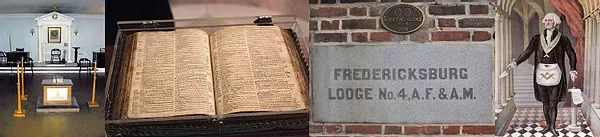
Fredericksburg Lodge No. 4 is in possession of several artifacts of historical value, including the Bible that Bro. George Washington took his Masonic obligations on, an original Gilbert Stuart painting of George Washington, three hand-crafted colonial Warden’s chairs, a lock of Washington’s hair, a punchbowl used during the visit of General and Brother Marquis de Lafayette to the Lodge in 1824, and a hand-written eulogy of Washington delivered to the lodge upon his death in 1799.
The Gilbert Stuart portrait of Washington was known to the oldest members of the Lodge when noted by M.W. Silvanus Quinn in his Lodge history. The George Washington Masonic Obligation Bible was printed in Cambridge, England by John Field, printer to the University, and dates from 1666 and 1668. It is gilt-edged, leather-bound, and contains fold-out plates and hand-written notes. This Bible was saved for posterity by the prudent actions of Wor. William Ware prior to the Battle of Fredericksburg, and is currently undergoing restoration efforts that will ensure its survival for generations to come.
Sources
Charles H. Callahan, “Washington – The Man and the Mason,” 6th Ed., George Washington Masonic National Memorial Association (1913).
Paula S. Felder, “Early Taverns Livened Up Fredericksburg,” Free Lance Star, Dec. 4, 1999.
Paula S. Felder, “Hugh Mercer: An unexpected life” Free Lance Star, Sep. 4, 2004.
Reginald V. Harris, “Freemasonry at the Two Sieges of Louisbourg 1745 and 1758”, Papers of the Canadian Masonic Research Association 1949-1976, Volume 2 paper 46, The Heritage Lodge, 1986.
Robert A. Hodge, “The Masonic Cemetery of Fredericksburg, Virginia” (1991).
Grand Lodge of Virginia, A.F. & A.M., “The History of the Grand Lodge of Virginia,” Grand Lodge of Virginia website.
Silvanus J. Quinn, “This History of the City of Fredericksburg, Virginia,” Hermitage Press, Fredericksburg, VA (1908).
R.W. Robert E. Simpson, “Virginia’s Grand Masters, 1778 – 2012,” Grand Lodge of Virginia website.
Michael Spencer, “Masonic Lodge No. 4,” Presentation to Fredericksburg Lodge No. 4 (2018).
J. Travis Walker, “A History of Fredericksburg Lodge No. 4, A.F. & A.M., 1752 – 2002,” Sheridan Books, Fredericksburg, VA (2002).